
Christendom
Missiles fly on the birthday of the prince of peace.

December 26, 2025
To my knowledge, the United States has never before taken military action in defense of a specific religious group. To the extent that perhaps we have, such as the 78-day bombing to end Serbian attacks on Muslim-majority Kosovo, it was framed not as fighting religious persecution, but the defense of the territorial integrity and autonomy of a people, and the rejection of ethnic persecution.
On Christmas Day, Donald Trump ordered strikes on suspected ISIS sites in Nigeria. The New York Times reported:
Mr. Trump said in a post on Truth Social that “the United States launched a powerful and deadly strike against ISIS Terrorist Scum in Northwest Nigeria, who have been targeting and viciously killing, primarily, innocent Christians at levels not seen for many years, and even Centuries!”
…The U.S. operation inside Africa’s most populous nation followed months of growing allegations by Christian evangelical groups and senior Republicans that Christians were being targeted in widespread violence.
In the abstract, U.S. military strikes to defend persecuted Nigerian Christians is no different than strikes to defend Muslim Kosovars, or steps to stop genocidal ISIS attacks on the Yazidi people of Syria, if anyone had actually done so.
But actions are never abstract, and Donald Trump may be a man enamored of symbolism, but abstract thought evades him. A military strike on Christmas Day framed in terms of the persecution of Christians is not, primarily, a defense of the universal right to a free conscience of all people. It is not, really, about persecuted Nigerians, or aimed to help them. It is a performative act of religious affiliation, with a domestic base in mind.
Will the United States position itself to be not the defender of freedom, but the defender of Christendom? Even as we retreat from the world to practice gunboat diplomacy in the Western Hemisphere, setting aside the leader of the free world mantle, will we extend American might on sectarian religious grounds?
There is nothing wrong with protecting Christians, per se. But to do so at the behest of Christians, explicitly on behalf of Christians, raises questions. Will we come to the aid of other ISIS victims? What have we done for the Yazidis, or for the Rohingya?
And this only adds to the issue:
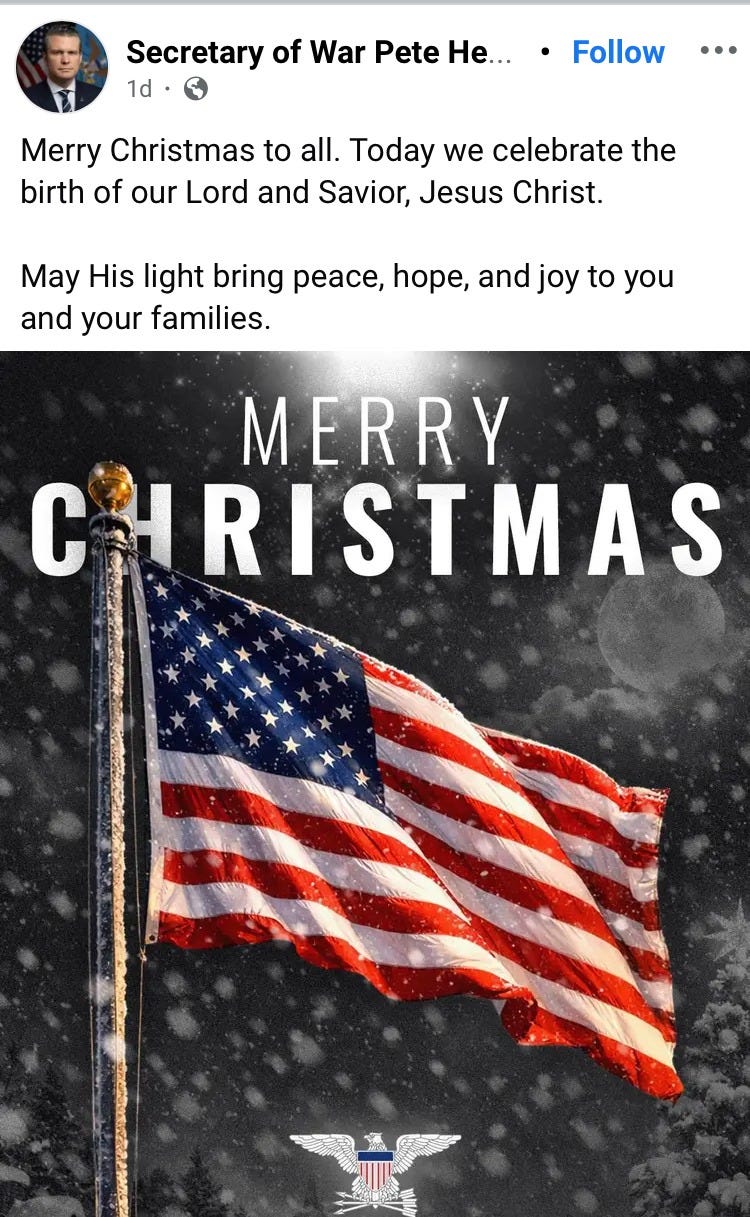
To say that the US will come to the defense of those of a shared religion, on that basis, is to shrink the circle of human rights, to revert to a more tribal view of our entanglement in the world. And this is consistent with the overall worldview of the Trump Administration, one that sees no universal rights or higher moral calling, no suffering that cannot be dismissed if other expediencies are more pressing. It is another example of the Putinist fragmentation of what America stands for.
If you doubt that the Administration acted out of expediency rather than any genuine concern for Nigerians under the thumb of brutal oppression, as yourself why we are not opening the doors to Nigerian asylum seekers, why white South Africans are the only ones Donald Trump cares to admit.