
Gunboat Diplomacy
Are we on the cusp of unfurling the "Donroe Doctrine"?

December 2, 2025
As warships accumulate off the coast of Venezuela and Trump bizarrely posts a warning on social media about closing airspace over the country, I find myself thinking back to what Treasury Secretary Bessent said about the Monroe Doctrine, justifying the bailout for Argentina, giving the one country more money than the total cuts made by dismantling USAID, as “an an economic Monroe Doctrine in terms of the Western Hemisphere.”
In its original form, the Monroe Doctrine made common cause with other nations emerging in the Americas as they threw off the yoke of colonialism. John Quincey Adams, Monroe’s Secretary of State, gave this directive to ambassadors sent to the fifteen new nations in what is now Latin America, in 1824:
With relation to Europe, there is perceived to be only one object, in which the interests and wishes of the United States can be the same as those of the South American nations, and that is that they should all be governed by republican institutions, politically and commercially independent of Europe.
Implicit was the concern that these new nations might not adopt democratic governance, and in this, what is now Latin America posed a dual threat: that it would fall to a new European power, that would gain a foothold to threaten the national security and interests of the U.S., and that these new nations themselves would end up hostile to the democratic project, and hence the young republic to the north.
But the rationale changed over time from its relatively idealistic roots. From the mid-19th Century onward, the doctrine became more insular and hostile, and was used to justify American interference in the affairs of the sovereign countries in the Western Hemisphere. An American political cartoon from the turn of the century indicates the expansionist attitude it came to embody:
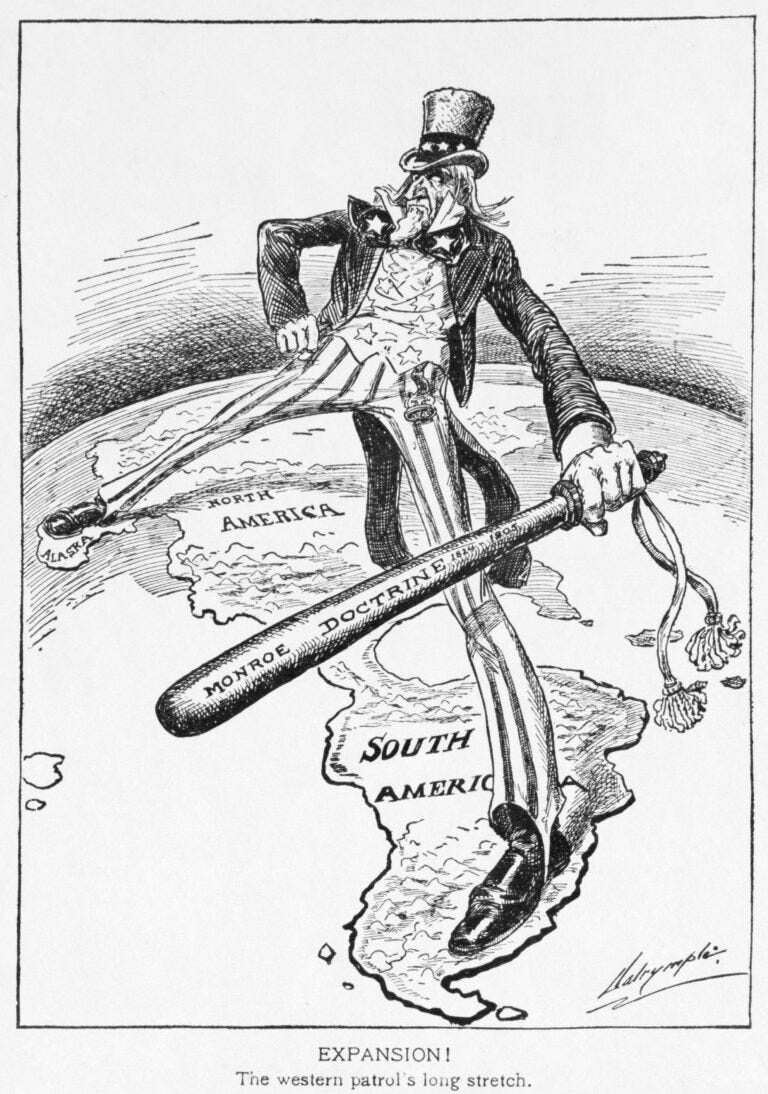
U.S. interference in Latin America kept the region destabilized for generations, with endemic civil wars and authoritarians on the right and on the left violating human rights liberally. There are few countries in the region that have not been touched, in my lifetime, by the long reach of the Monroe Doctrine.
Things have changed. The end of the Cold War removed the most recent pretext for Yanqui meddling in the internal affairs of Latin American nations. The region pioneered many of the accountability measures now known as “transitional justice,” with truth commissions and prosecutions that brought abuses to light and ended impunity for those who ordered murders on a horrifying scale. The lucrative cocaine trade continues to foment violence in many places, and provides a pretext for some U.S. covert engagement. But in general, this century has seen improvement for many millions of people in the region.
Are we on the cusp of going back to our old ways? Does the Administration see a land war to remove Nicolás Maduro as a viable option? The Guardian has its doubts:
James Story, the US’s top diplomat for Venezuela from 2018 to 2023, also doubted a Just Cause-style onslaught was coming: “We always like overwhelming force and it would take 100,000 troops – and that’s not Trump.”
…[Historian Michael] Grow thought a better analogy than Panama was what happened in Guatemala in 1954 when the US brought down its democratically elected president, Jacobo Árbenz, with what the historian called “a masterpiece of psychological warfare and bluff”.
Operation PBSuccess – ordered by Dwight Eisenhower to extinguish a spurious communist threat – involved using a CIA-funded disinformation and sabotage campaign to convince Guatemalan military officials they were on the brink of being attacked by “a powerful liberation army” and should abandon Árbenz to avoid “devastating US retribution”.
It seems as though this option has been tried. Last week, Donald Trump and Marco Rubio spoke by phone to Maduro, offering a meeting in Washington DC (where he would likely be arrested, after the Administration named him the head of the spurious “Cartel de los Soles”). Responding to Trump’s kleptocratic leanings, Maduro offered the U.S. “a significant stake in the country’s oil fields, along with a host of other opportunities for American companies,” in exchange for remaining in power. This was rebuffed.
Maduro is unpopular – his approval ratings hover near Trump’s (and Trump could arguably learn something from Maduro to bolster his authoritarian aims). He is an autocrat, and his country suffers. But it is difficult to even entertain the notion that any lofty ideals motivate the Administration’s hostility.
An invasion to topple Maduro would likely destabilize the country, but it would have regional and global implications, as well. Given the history of U.S. intervention, even limited air strikes inside the country would likely fuel popular discontent and strengthen support for Venezuela among neighboring countries as anti-American sentiment sweeps across the region, souring relations with Washington and emboldening anti-American political movements. “Nation building” has been discredited in the U.S. after our disastrous efforts in Afghanistan and Iraq, and I cannot imagine an administration less competent to help rebuild a country torn apart by corruption and repression than this one. Venezuela would struggle to rebuild itself, the Trump team would do too little to help. Depending on the nature and duration of military engagement, a U.S. intervention could lead to as many as four million people fleeing the country. All of which would lead to more upheaval throughout the region.
Destabilizing Latin America will, in turn, lead to more people seeking to come to the U.S., which is antithetical to the stated goals of the Administration, though it would provide cause for upping the mass deportation ante, the linchpin of any strategy to erode constitutional protections in the U.S.
Globally, such a move would weaken alliances and norms that have long protected the peace. A U.S. invasion of Venezuela would be constructed on dubious moral foundations. The designation of drug traffickers as a form of terrorist is intended to make small boats legitimate military targets, but it is a huge stretch. When the Administration named Maduro the head of the “Cartel de los Soles,” and the cartel a terrorist organization, it was a move similar to the designation of “antifa” as terrorist – the term cartel de los soles appears to be a moniker used to describe members of the military corrupted by narcobusiness, a real problem but not a formal organization, let alone one using violence for political ends.
To invade on these grounds, in short, would be to use a flimsy pretext to justify what is otherwise a war of aggression. Vladimir Putin, certainly, will recognize the parallels to his invasion of Ukraine. And, as he did when his “foreign agent law” was criticized, he will use our actions to justify his own. Venezuela will become, at least for Putin, America’s Ukraine.
Perhaps this is fine, as far as Trump is concerned. For nearly a year, he has shown disdain for the “rules-based international order” and an interest in returning to an earlier, spheres of influence model of geopolitics, one in which Russia, China and the U.S. have free rein, as far as the other regional powers are concerned, in their own global backyards. A newly muscular, less altruistic, legally unconstrained Monroe Doctrine would push us closer to such a world; some have come to refer to emerging policy as the “Donroe Doctrine.” And indeed, the positioning of 25% of our total naval assets are now in the Caribbean, up from 14% a month ago, is a development that makes it plausible that U.S. military dominance of the hemisphere is in the cards, as well.