
What is it good for?
Absolutely nothing makes sense to me about why we are going to war with Iran right now.

March 1, 2026
I was packing to return home from Portland at 3 am yesterday when I heard the news about air strikes on Iran. A day in the air and a lost charging cable kept the news at bay for the remainder of the day.
New York Times
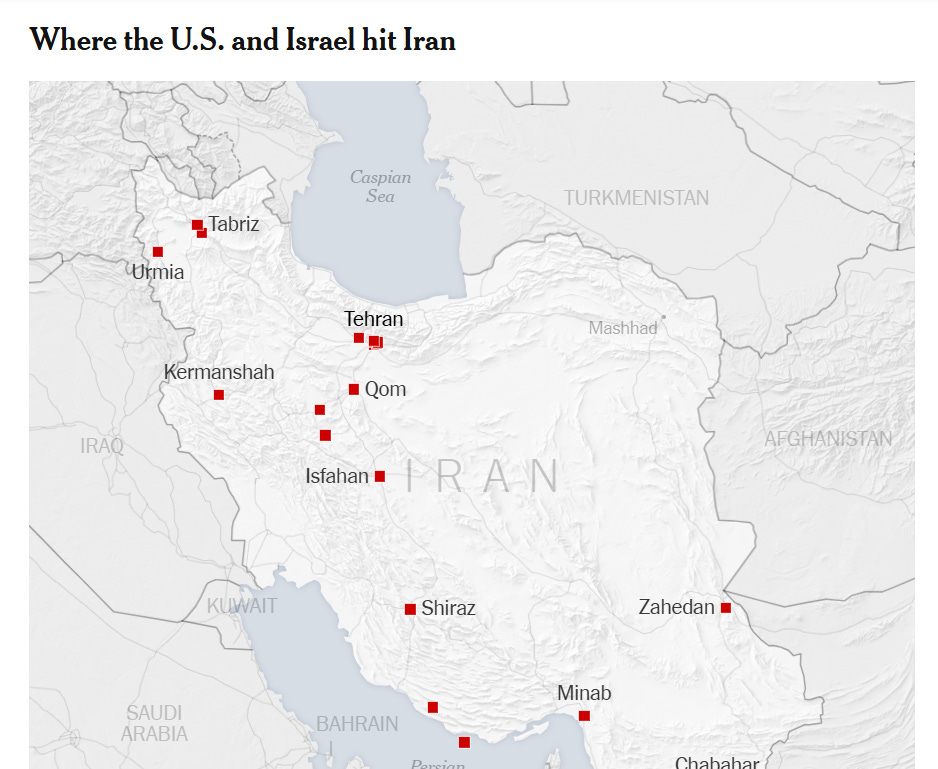
It’s hard to really understand why the U.S. saw regime change in Iran as an urgent priority now, because the government did little to make its case to the American public. There were no televised Congressional hearings (was Congress consulted at all?), no press conferences. There were a few tweets from officials. As the drumbeat of war goes, that’s a tambourine.
Why did they do it? The Iranian government was a terrible regime, sponsoring terrorism, assassinating dissidents abroad, torturing and murdering their citizens and turning the military on others when they protest those deaths. But none of that is so shocking to a man who allies with Putin and extols his love affair with Kim Jong Un.
The other day, I posed a question that I frequently ask myself: is that a strategic decision, or a stupid one? Frequently, I cannot tell, and maybe, I concluded, that is because it is often both.
A massive attack on Iran, coordinated with Israel, looks like just pure stupidity to me.
When George Bush set out to invade Iraq, he had what nonprofit activist types call a “theory of change,” a set of assumptions that describe the systemic effects a given intervention might have, how other contributing factors might change the outcomes, and what the long-term results might be. In the case of the Iraq war, the theory was that if we depose one of the most brutal dictatorships in the Middle East and replace it with a functioning, prospering democracy, there will be a domino effect that will lead to changes regionally, empowering citizens of many nations, and sapping the alienation and resentment that terrorism thrives on.
Theories of change are always wrong, but few are as catastrophically wrong at this one. But at least there was one.
What is the theory of change that undergirds the bombs falling on Tehran? What is the anticipated outcome of killing the Ayatollah? At a time when FBI agents have been diverted from counterterrorism to support deportations, at a time when warfare is being rapidly transformed by technology, what is the risk mitigation plan?
The sense that this was an impulsive move is heightened by reporting in the Wall Street Journal that the military warned Trump about an alarming lack of readiness:
When the U.S. military’s top general laid out the risks to President Trump of launching a major and extended attack on Iran, one of the issues he flagged was America’s stockpile of munitions.
Now that is being put to the test, as the U.S. races to destroy Iran’s missile and drone force before it runs out of interceptors to fend off Tehran’s retaliation, current and former officials and analysts say.
So why do it now? Why, however terrible the Iranian government is, do it at all? If it is necessary, absent a clear and imminent threat, why did no other President go that far?
The cynical answer is that it is “wagging the dog,” a distraction from the growing threat the Epstein case poses to the presidency. Ordinarily, I would probably wave that away. Sure, Bill Clinton sent cruise missiles at Osama Bin Laden’s Sudanese hideout right around the time that the Starr Report was released. But a full-scale bombing of Iran commits the U.S. to a real war, one that could lead to American boots in the line of fire, ships sinking in the Strait of Hormuz, a Russia-style quagmire, or that could lead to a regional conflagration, as Hezbollah and the Houthis lash out in support of their benefactors, as the remnants of the Islamic Republic’s allies in Syria tear apart the fragile peace. It is hard to imagine – though with this crowd, it is certainly possible – that the U.S. government would take such a drastic and possibly disastrous step when other distractions present themselves every day.
That is where the stupid comes in regardless of whether distraction is a motivating factor. The Administration does seem to believe that this, and all things, will be easy for our recently Hegseth-ified military. Donald Trump said this morning that he is prepared to talk with the new, living Iranian leadership, suggesting perhaps that he thinks that the decapitation of the nearly fifty-year old revolutionary Shiite government will play out the way that the capture of Maduro did (or how he thinks it has). As the bombs fell, he urged Iranians to rise up against their government, perhaps forgetting that he urged on protestors with implicit, false promises of U.S. support in 2018. He seems to think this might be easy. And perhaps it will be. But as missiles fell on Israel and on U.S. bases in the Gulf, the chances of a short engagement seems slim.
Could it be that they didn’t provide a rationale to the American people because they didn’t have one? Could it be that the decision was made by an impulsive president and an administration that collectively, worshipfully, trusts his gut?
My guess is that this is another war about nothing, that is, the rationale for it is exactly that we do not have to have a rationale to go to war. “You can talk all you want about international niceties and everything else. But we live in a world, in the real world, Jake, that is governed by strength, that is governed by force, that is governed by power. These are the iron laws of the world,” as Stephen Miller recently put it.
But those are not the iron laws of the world, for two reasons. First, after the Second World War left millions dead, societies exhausted and reduced to rubble, the nations of the world set rules that have held, far from perfectly, but well enough that most conflicts have been internal or bi-national; aside from the Balkans and the conflict in the Democratic Republic of Congo, there have been few multi-national, multi-front conflicts that draw in more combatants and seem to multiply atrocities on the battlefield and off. The multi-directional affrontery of the Trump Administration, more diplomatic than military, seems designed if it means to do anything to undermine this eighty-year-old “rule-based international order.”
This is profoundly, disastrously, go-down-in-infamy-ly stupid.
The other way that Miller’s iron laws of the world are bullshit is that being the strongest very often is not enough. There is a reason that David killing Goliath is a story that has resonated for thousands of years. A simple stone, combined with the right amount of cunning, beats all the strength, all the weaponry, all the size that the world can provide. A half century after Vietnam, and a lifetime since the semi-analog days when the Black Hawk went down and when George Bush commissioned the “mission accomplished” banner, we seem to have forgotten about asymmetrical warfare, about the limits of imperialism by occupation, of the complexities and dangers of picking a fight with someone who can’t win on a battlefield, but can inflict tremendous and tragic costs off it.
As I mentioned the other day, the Ukrainian war is creating new, drone-based military strategies that confound larger but less technologically prepared armies. News reporting on the “Hedgehog 2025” military exercises suggest new vistas for asymmetrical war. Defense 24 reports:
One of the exercise episodes revealed the scale of the problem. A large NATO grouping, including a British brigade and Estonian units, operated as if full battlefield transparency did not exist. Units moved without sufficient concealment and deployed vehicles and equipment in easily detectable positions. A team of roughly ten operators was able within half a day to simulate the destruction of 17 armoured vehicles and conduct around 30 additional strikes, while more than 30 drones operated on an area smaller than 10 km². In the assessment of the exercise, two battalions were declared combat-ineffective.
The conclusion should be interpreted carefully. The exercise did not represent a real battle, and simulated drone hits were treated as successful engagements for training purposes. The aim was to test procedures and resilience to mass drone use rather than defeat NATO forces. The results nevertheless showed how transparent the modern battlefield has become and how vulnerable concentrated formations are without dispersion, camouflage and rapid exchange of information.
Another problem identified was the speed of decision-making. Ukrainian forces share operational data quickly between command and subordinate units, accelerating strikes. In several Allied militaries the tendency to restrict access to sensitive information slows reactions and complicates coordination. Estonian officers described the results as alarming, while observers stressed that recognising the problem is only the first step; doctrinal changes, training adjustments and procurement decisions must follow.
The broader lesson is not that drones alone win wars, but that they significantly alter tempo and organisation of combat. Even well-equipped armies may encounter serious difficulties if structures, doctrine and training remain aligned with earlier models of warfare.
Iran both has a potent standing military and a long history of supporting guerilla/terrorist operations like the Houthis of Yemen. Iranian agents have murdered at least 457 dissidents in 19 countries around the world. A longtime ally of Russia, it is not only likely that they have been studying developments in Eastern Ukraine, but also possible that they have access to some Russian analysis of the situation. In a protracted war, they would likely be both a conventional and an unconventional opponent. A protracted conflict with Iran likely will be one with no clear front, no national boundaries that matter, no place that is safe.
There are many, many problems with the iron law element of the Trump Doctrine. The fact that, in their hubris, Trump, Hegseth, Miller and others seem to feel that their military superiority translates to both invulnerability and infallibility is not the most morally significant problem, but it may be how we remember their regime when, eventually, Trump and his government pass into history.
God be with our military. They (and us) deserve to know why they are there.
💔😔