
Sundown
The truth that an ugly myth tells about American history and historical attitudes towards immigrants.

May 23, 2026
Sometimes, the actual, brick and mortar, blood and soil thing is its own metaphor.
A couple days ago, I wrote a somewhat gauzy piece on the United States’ historical relationship to immigration. My aim was to capture something central and hopeful about the kind of society we came to be, but I recognize that there is a dark underbelly to the sunny topside of this story.
I described the heart of our culture as residing in a process of mutual adaptation, as new arrivals acclimate to their new cultural environs, and those environs change, taking on bits of the ideas and norms of those it assimilates. This process, I suggested, was one performed “fitfully and with a great deal of violence.”
Here is that side of the story writ small.
Recently, I had lunch with a high school friend who used to teach the cultural geography of Oregon. She told me a shocking story, one that was believable, too believable, for being emblematic of the history of the state.
Oregon has a checkered past. Though it is one of the whitest states in the Union, Oregon has a long history of immigration – and backlash. The constitution of the new state, adopted in 1859, forbade people of African descent from permanent residency. Touted as a way to stay out of the soon-to-be violent debates over slavery roiling the nation, the prohibition was successor to an 1844 “lash law” that mandated 30 lashes every six months to any Black person who did not leave the territory after a specified amount of time. The prohibition stood until a constitutional amendment passed in 1926. Seventy-six years later, another amendment removed racist language remaining in the document after that change.
In the early 1920s, Oregon was a Klan-dominated state; corruption and adverse legal rulings had begun to sap Klan power by 1926 when the exclusion was repealed. But things didn’t necessarily change, and I suspect the constitutional amendment was a result of embarrassment rather than a sense of justice: no other state had such a blatantly racist clause in its founding document.
Racial covenants proliferated and persisted after 1926 until well into the 20th Century, limiting housing options for Black Oregonians and others. The effect was pronounced:
In 1890, 17 of Oregon’s 32 counties had 0-10 African Americans living in them.
However, by 1930, 28 of Oregon’s 32 counties had 0-10 African Americans living in them. African Americans were pushed from rural communities into condensed urban settings. It is estimated that most of Oregon was once a sundown town.
A “sundown town” is an all-white enclave where others may visit, but if you aren’t white, you’d best be gone before darkness falls. I associate them with the South, and was surprised to learn they were a thing in the Northwest, which is honestly a bit odd. The south is a divided racial amalgam, but Oregon was (and is) virtually all white. This is not the accident of history I grew up believing: early settlers seem to have wanted to create a whites-only region (on long inhabited lands). Sundown towns, like lash laws, racial covenants and Klan-endorsed governors, are a part of the enforcement.
But growth and opportunity inevitably invite migration, and while the Black population of the state as a whole was tiny and falling, the Chinese population was growing. According to Oregon Public Broadcasting,
Chinese people were among the earliest nonnative settlers in Portland. A photograph in the Oregon Historical Society Digital Collections from the 1850s shows the Hop Wo Laundry already established among the first buildings on Front Street.
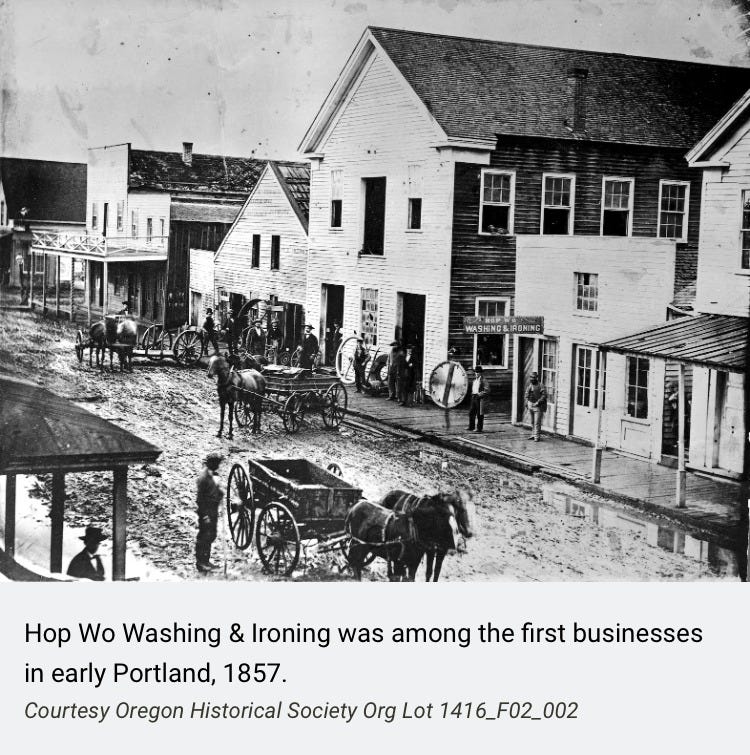
According to historian and author Marie Rose Wong, at one time, Portland’s Chinatown was the largest in the country.
“When the Chinese started moving into Portland they could literally live anywhere a person was willing to rent them property, and that is exactly what they did. In terms of geography, it was much larger than San Francisco.”
But Portland wasn’t Oregon; it never has been. A bustling, crime-ridden port city, 95% male in its early days, it was inhabited but perhaps not really settled. People came there to buy and sell, to transport felled trees in by raft or wagon from the Cascades, to sail lumber and other goods out to the world and back. It was a transient population to a greater degree than many places, and transience can masquerade convincingly as tolerance.
Settler towns perhaps were different.
Pendleton is an Eastern Oregon town that began as a High Desert trading post. Famous for its wool blankets and its rodeo, with a railroad stop and the Columbia river nearby, it became one of the largest wool producers in the country.
It was a roughneck kind of place, with a more-than-proportionate number of saloons (at least 30) and brothels (18). Cowpunchers spent their days off from ranching there, and it has been described in its heyday as a “Cowboy Vegas.” The Pendleton Roundup, established in the nineteen-tens, was a celebration of this heritage.
As in every boomtown across the West, Chinese immigrants came to Pendleton. They were not welcomed, but they established businesses, and a small community.
Pendleton was also once a sundown town. The city’s informal sundown rule targeted Chinese residents, though women, too, were informally confined after dusk.
This came up over lunch with my friend when I mentioned taking a “shanghai tunnel” tour in Portland, and she mentioned a similar experience in Pendleton. In Portland, the tunnels in question were built to convey goods from the docks into town, but they quickly came to be used for human trafficking. “Shanghai” in this context is not a proper noun but a verb: it refers to the practice of drugging able-bodied men and dragging them onto ships where they would wake up in blue waters and into forced labor as sailors (“crimping” was the more common term then; I don’t know when or where “shanghai” was coined).
Pendleton’s tunnel system, it has been claimed, was something very different.
It is – or maybe never was – a system connecting basements in central Pendleton, reputedly rediscovered in the 1970s because of the city’s infamous and growing pothole problem. The story goes that, forced at dusk to leave this small city surrounded by dry, inhospitable grasslands, Chinese workers and business owners retreated literally underground, carving out tunnels and rooms, building an underground village, safe from the violent streets above, that they called home.
This is almost certainly false (and more than a little racist). What seems to have been true is that the sundown rule was enforced, but presumably, this meant that people were confined to their own, aboveground homes under threat of violence. Offbeat Oregon suggests that the risk was more serious for Chinese residents and for women, but could be said to include any sensible person:
The upshot of all this rowdiness was that Pendleton was very much a “sundown town” back in the day. It was like an unwritten law that, especially on a Friday or Saturday night, nobody who wasn’t a young cowboy with a pistol on his hip and a bottle in his hand should ever risk being caught out on the streets of downtown after nightfall.
There were sidewalk vaults and some underground businesses in what they now call the underground, and perhaps Chinese residents and others caught out at night might have sought refuge in these places.
The threat of violence for Chinese Oregonians in the 19th Century was frighteningly real, their personhood in the eyes of law and community always up for grabs. The constitution that barred African-Americans from living in the state also prohibited Chinese residents who arrived after it was adopted from owning property or a stake in mines. Scapegoating and violence against Chinese workers was common. And one of the worst massacres in U.S. history targeted Chinese miners not far from where Pendleton was being established, according to the OPB article:
In the fall of 1886, a group of Chinese people set out from Lewiston, Idaho, up the Snake River and set up camp along a small stream known as Deep Creek. They mined the area for fine gold powder that may have netted them a few thousand dollars.
Then in May 1887, locals discovered bodies floating down the river. Other Chinese people in the area identified them as employees of the Sam Yup Company from San Francisco. The company offered a reward and hired a local investigator, while the Chinese consulate officially complained to the U.S. government.
Despite these efforts, the investigations didn’t turn up much until March of the following year, when Wallowa County rancher Frank Vaughan turned state’s evidence against six others.
According to a New York Times article from 1888, Vaughn’s statement read, “We entered into an agreement nearly a year ago to murder these Chinese miners for their gold dust…the men went down to the camp and opened fire on the Chinamen, killing them all.”
Dozens died. Chinese residents of the Western U.S. had much to fear, even if it did not drive them to live in basement shadows.
But Pendleton Underground the myth persists, an odd example of a literal thing (a few connected underground spaces) symbolizing an abstract one, the effect of fear of violence that drove people metaphorically underground at night.
First hearing about the Pendleton underground, the theory put forward by tour operators that it was a literal underground home for fearful Chinese workers between sundown and dawn, I thought of the end of Invisible Man, when the main character retreated to a subterranean vault, lit by dozens of bulbs and stolen electricity. His subterranean life is both defiant rebellion and resigned capitulation to a racist society that will not hear his voice, see him as a man among others. I wondered if Ralph Ellison did not somehow know the myths of a small mill town on the other side of the continent when he wrote what may be the greatest of all
great American novels.
The underground refuge of terrorized Pendleton residents is a falsehood, but one that expresses a deeper truth. As the OPB article above indicates, violence against Chinese immigrants, and impunity for that violence, was endemic in the so-called Wild West.
Like the Pendleton Underground, my notion of the U.S. as a “syncretic state” is kind of a myth, at least if you suppose it to mean that Americans welcomed and consciously adopted from new arrivals. It captures something true – that American culture was built out of parts from all over, many so subtle and accepted that their origins go unnoticed, many, in the far western states especially, from China, Japan and other Asian sources. But those influences flowed underneath more turbulent surface waters, where white Americans, interlopers in these parts themselves, bristled at the different customs of other arrivals, inventing racist stereotypes that included the idea of underground opium dens and other Chinese sneakery.
The truth is complicated. I use the idea of the amalgam of a culture of the U.S. to suggest that Stephen Miller’s xenophobia is un-American. But of course, Miller has a firm place in the eclecticism of his homeland. He would have been right at home with a sixgun in the dusty Pendleton streets, forcing Chinese residents indoors. (Ok, those Eastern Oregon roughnecks woulda killed him. But he would have cut a believable figure on the floor of Congress in 1882, calling for passage of the Chinese Exclusion Act.)
We might do well to keep the Pendleton lie alive for the truth that it conveys. Miller’s agenda is to curb legal immigration and make all immigrants fearful, to send roving posses out to Home Depots and hospitals so that undocumented migrants cannot show their faces. I cannot think that the literal interpretation of the Pendleton Underground would trouble him any more than the figurative one he is trying to recreate at scale.
Stephen Miller is not us, but he is part of us; history and the national psyche of this nation are shot through with the hatred and violence he represents. But most Pendleton residents in its wilder days were not cowpokes with too much liquor and a psychopathic streak; most Americans then and today do not hate their neighbor. We should recognize that, in the American spirit, Miller represents something real, something deep, but also small.
I was raised in Portland in the 50’s and 60’s. There was 1 black family in our exclusive neighborhood. When they moved in, our many neighbors brought a petition to our door and asked my father to sign it. It was to pressure the property owner NOT to sell his property to the black family. My father instead, did not sign it and purchased the property on the other side of the parcel in question. My family invited the new family to dinner. Contrary to what that letter suggested, they had the best kept lawn and house, their children were honor roll students and they were perfect neighbors and community members.
My father never minded that the rest of our neighbors ostracized him for not signing that petition. He was well accepted in other circles. He was a Veterinarian and loved people as much as he loved animals.
Here's what I think most people today interact with minorities all the time and they don't think about it. But the Republicans and especially Trump have convinced them minorites are bad so they rationalize it by thinking that the ones they know and interact with are the "good ones" while this amorphous group of minorities "out there" where people are definitely not the same as the people they interact with everyday are bad and criminals. So they hear "we are going after the worst of the worst and rationalize it. Of course there's out and out racist like my ex boss that collects ssdi while running his own Marina that yells all the time I would get more benefits if it weren't for all these illegals ripping off the government. Which blows my mind he's literally waste fraud, and abuse but he's obsessed with illegals getting benefits!